
When you are considering veneers, you want a result that looks natural, holds up over time, and is worth the investment. One question deserves a clear answer before anything else: how long do they actually last?
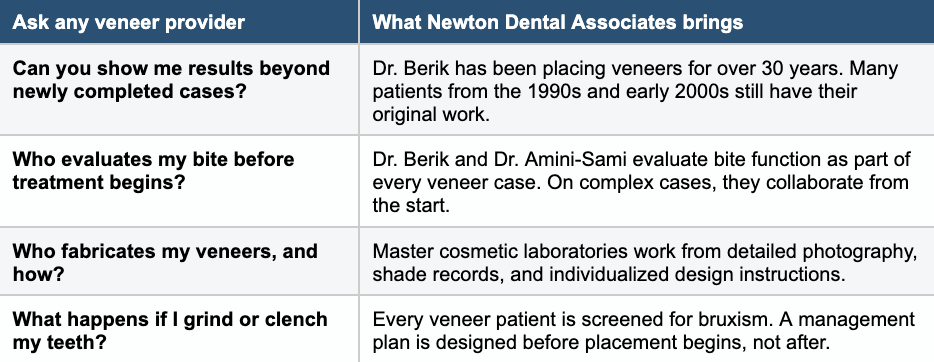
The honest answer is that porcelain veneers, placed by the right hands with the right laboratory, are one of the most durable cosmetic dental treatments available. They do not stain the way natural enamel does. They do not decay. Dr. Berik has patients from the 1990s who still have their original veneers.
What the research rarely tells you is that longevity has almost nothing to do with the porcelain itself. It has everything to do with what happens before the first tooth is ever touched.
Five Things That Determine How Long Your Veneers Last
1. Who designs and places them
A dentist who places veneers occasionally brings a different foundation than one who has spent decades designing cosmetic cases and following those patients over time. The preparation of the tooth surface, the design of the margins, and the judgments made at every step reflect experience that accumulates over years, not courses.
Dr. Anna Berik has been creating veneer cases in Newton and Boston for over 30 years. Dr. Ashley Amini-Sami, our Harvard-trained board-certified prosthodontist, collaborates on cases that require advanced cosmetic and restorative coordination. Between them, they bring a depth of combined experience that is rare in a single practice.
2. The laboratory that fabricates them
Your dentist designs the case. A dental ceramist brings it to life. Shape, translucency, surface texture, and the subtle color variations that make veneers look like real teeth are all determined at the laboratory level.
Newton Dental Associates works exclusively with master cosmetic laboratories for veneer cases. Detailed photography, shade records, and individualized design instructions go to ceramists who specialize in high-aesthetic restorations. When a veneer fails early, it is rarely the porcelain. It is a fit or bonding issue that traces back to laboratory precision. Elite laboratories produce tolerances that standard labs cannot match.
3. Whether the bite was evaluated first
This is the step most patients do not know to ask about.
Your bite places force on your teeth every time you chew. If veneers are placed without a thorough evaluation of how your teeth meet and where forces are distributed, they will eventually bear stress they were not designed to handle. That leads to chipping or debonding years earlier than it should.
Both Dr. Berik and Dr. Amini-Sami evaluate bite function as part of veneer planning. Dr. Amini-Sami’s prosthodontic training gives her specific expertise in identifying how bite forces can affect a restoration over time and designing cases that account for them. This is not a step that gets skipped at Newton Dental Associates.
4. Whether grinding or clenching is identified and managed
Bruxism is one of the most common reasons veneers are replaced earlier than they should be. Grinding generates forces that exceed normal chewing by a significant margin, and porcelain, though strong, has limits under repeated high-load contact.
Bruxism is not an automatic disqualifier for veneers. What matters is whether it is identified before treatment begins. Every veneer patient at Newton Dental Associates is screened for signs of grinding. For patients where veneers are appropriate, a management plan is put in place before placement, typically a custom night guard and, when indicated, therapeutic Botox to reduce jaw muscle activity. Some patients are not good candidates for veneers because of unmanageable grinding, and an honest evaluation will tell you which category you fall into.
5. How you care for them afterward
Veneers do not require complicated care. The habits that protect them are the same ones that protect natural teeth.
- Brush twice daily with a soft toothbrush and non-abrasive toothpaste
- Floss daily and keep your regular cleaning appointments
- Avoid biting into very hard foods directly on the veneer edges
- Wear a night guard if one is prescribed
- Avoid tobacco, which stains the bonding material at the gumline over time
Most patients find that caring for their investment comes naturally once they are proud of how their smile looks.
What to Ask Any Veneer Provider in Boston
The right questions tell you more than a price quote or a portfolio of newly completed cases.
When Do Veneers Actually Need to Be Replaced?
Reaching a particular anniversary does not mean your veneers need to come off. They are replaced when something changes: a chip or crack, gumline recession that exposes the margin, bonding failure, or a patient who wants to update the look of an otherwise functional set.
Patients who maintain their veneers well, address grinding if it exists, and see their dentist regularly routinely get 20 years or more from a well-placed set. The 10-year figure that circulates online reflects population averages that include poorly placed veneers, lower-quality labs, and patients who did not maintain them.
When replacement is needed, the process is similar to the original placement. In most cases, the underlying tooth is in excellent condition because porcelain protects the enamel beneath it.
Thinking about veneers? Choose Newton Dental Associates
A consultation with Dr. Berik takes about an hour. She will evaluate your teeth, discuss what you want to change, and give you a clear picture of what treatment would involve and what to expect over time.
Most patients leave knowing whether veneers are right for them. Some leave relieved that a simpler option will accomplish what they want.
You can start with a concern as simple as, “I do not like how this tooth looks in photos.” We will help you understand the options from there. Contact Newton Dental Associates at 617-965-0060 to speak with a dental expert from our team.
Questions Patients Ask About Veneer Longevity
Porcelain veneers placed by a trained cosmetic specialist typically last 15 to 20 years, and many patients keep theirs considerably longer. Longevity is determined by the quality of planning and placement, the laboratory, the bite evaluation, and how well they are maintained afterward.
The most common causes are an inadequate bite evaluation before placement, unidentified or unmanaged bruxism, poor fit from a lower-quality laboratory, and improper bonding technique. All of these are identifiable in a thorough consultation before any treatment begins.
It depends on the extent of the grinding and the overall condition of your teeth. Many patients who grind can proceed with veneers once a management plan is in place. Some are not good candidates. An honest evaluation at your consultation will tell you which category you are in and what your options are.
For the right patient, yes. Veneers address multiple cosmetic concerns simultaneously with a single treatment, protect the enamel beneath them, and require no maintenance beyond normal oral hygiene. If your main concern is color, whitening may be enough. A small chip may be treatable with bonding. A consultation determines which option actually fits your situation.
Nothing beyond what a healthy smile already requires. Non-abrasive toothpaste, regular flossing, professional cleanings, and a night guard if grinding is a factor. The porcelain itself cannot decay, but the natural tooth beneath it still needs to be maintained.